
The Trust Compass
Part II- Building and repairing trust in social justice movements

It is time for a shift in how we think about trust.
Over fifteen years ago, I set out to understand how improving our relationships could help us have greater impact. I studied trust in social justice spaces, in the research, and in my own life. What I found fundamentally changed how I view trust.
Many great thought leaders have contributed to the discourse on trust. Stephen Covey and adrienne maree brown invite us to move at the speed of trust, Brené Brown explores trust and vulnerability, and Robert Putnam articulates trust’s role in civic life. Their work matters and has a profound impact on the field.
And at the same time, I began to notice patterns. When it came to race and power, many thought leaders often ignored it, treated it as an afterthought, or defaulted to deficit thinking. I also noticed that with a few exceptions, the majority of trust’s thought leaders were white and mostly male.
The Missing Piece
I began searching for work on trust that centered marginalized voices. Early on, I discovered Dr. Shayla Nunnally’s book, Trust in Black America, which focuses on what she calls racialized trust. Racialized trust describes the ways in which Black and White Americans experience trust differently because of systemic racism. This was the missing piece. Dr. Nunnally’s work offers a detailed account of how trust was shaped by our identities and our experiences.
As I dove deeper, I learned about the land back movement and reparations as efforts toward healing broken trust with Indigenous and Black communities. Beginning with my dissertation study and extending into the work of Center for Trust and Transformation over the last five years, I have talked to hundreds of people working toward social, economic, environmental, and disability justice who described the myriad ways people from different cultures and backgrounds think about trust. It opened my eyes to a whole new way of thinking and laid bare the truths and limitations of our current definitions of trust.
Shifting the Trust Paradigm
I am not the only one who thought something was missing when it came to defintions of trust. Renowned therapist Esther Perel once noted: “When I went to look at research [on trust], what it fundamentally said is that there is an absolute definitional void. It is one of those concepts that is swimming in vagueness.”
Despite this vagueness, we are obsessed with defining trust. Maybe it is the intrigue of finding a foothold in the noise. Charles Feltman defines trust as “choosing to risk making something you value vulnerable to another person’s actions.” Rachel Botsman calls it “a confident relationship with the unknown.” There is nothing fundamentally wrong with these definitions, but they are one-dimensional in my view.
Experiences like love and spirituality are complex human occurrences, and we each carry our own definitions and beliefs about what they look like in practice. Take love for example. It is assumed that we have different definitions and experiences of love, and our work is to understand the contours of each other’s perspectives. We implicitly know that someone’s beliefs around love are shaped by family, friends, and life experiences. We often experience love as both an emotion and a choice.
Trust is no different.
So if trust and love operate similarly, that means the goal is not to have the same definition of trust but rather to better understand each other’s definitions of trust.
When we do this, we acknowledge that there are life experiences, social circumstances, and personal beliefs that inform who and how we trust. This does not mean we have to stop using universal definitions, but we do have to be curious about what these look like in practice for different people with different experiences.
I believe our current limitations for examining how culture and context impact trust are holding us back. This is particularly true in social impact spaces where we are working within and around systems that are deeply impacted by systemic racism and toxic power dynamics. If we are to tip the scales toward justice, we can no longer overlook the role that culture and context have on trust.
Introducing The Trust Compass
The Trust Compass is a navigational tool. It can help us wrap our heads and hearts around what it takes to build and repair relationships in ways that honor ourselves and each other. It will not illuminate every issue or resolve every conflict. But it will help leaders see a fuller picture of how relational dynamics are impacting a situation. The Trust Compass can help people move beyond “this person is untrustworthy” to “what is happening beneath the surface, and what does repair require?”
The Trust Compass is a tool I’ve used for over a decade with clients and friends who are navigating relationships and repair. It helps us get curious instead of defensive. It helps us ask better questions. It helps us build a trust that is strong enough to withstand time and tension. In future articles, I will talk about why trust is so critical, but needless to say it is the glue that holds movements together.
Four Trust Compass Dimensions
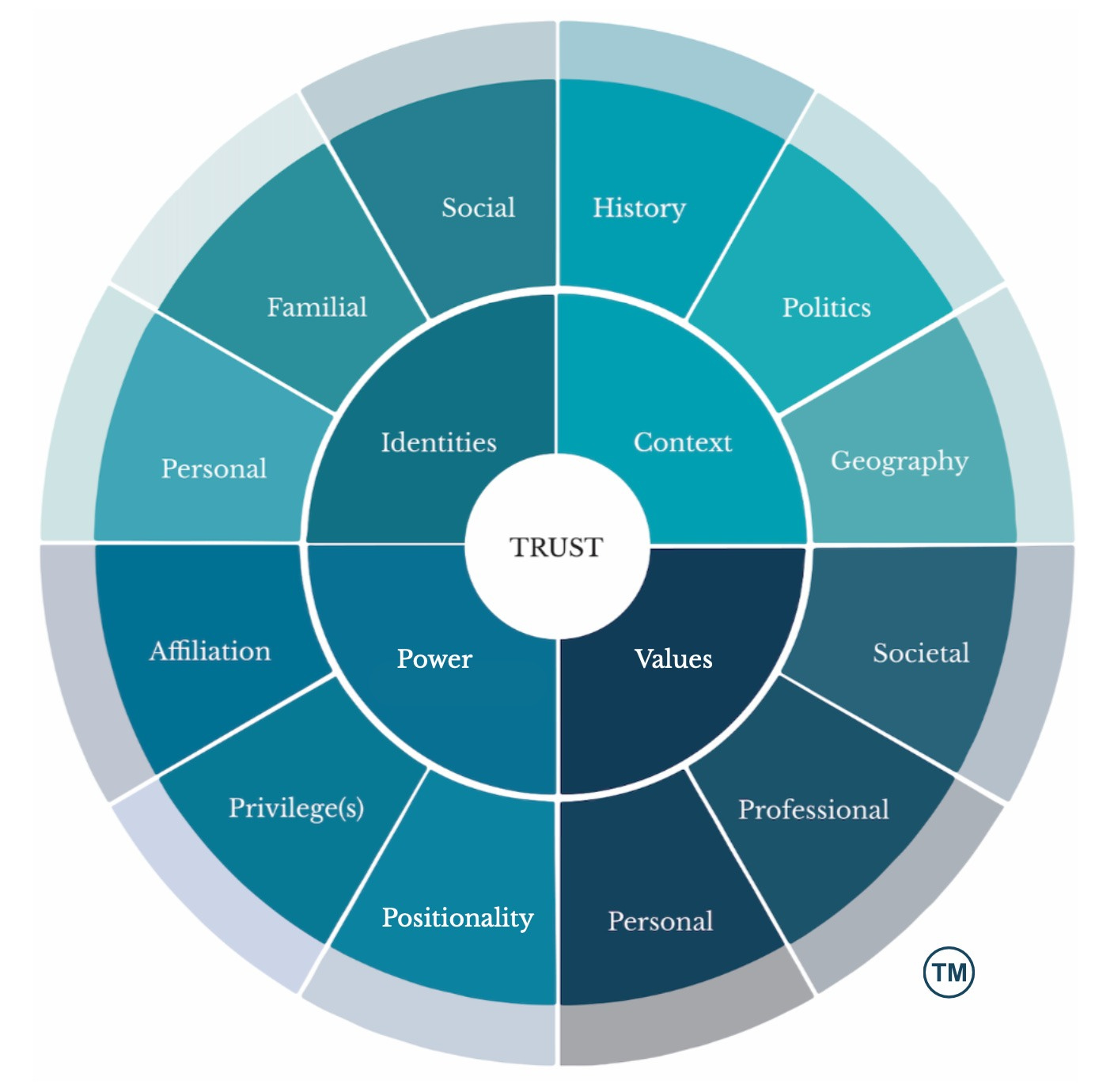
The Trust Compass (Copyright, Center for Trust and Transformation, 2025)
The Trust Compass is a tool designed to help us navigate trust in the context of our individual and collective experiences. It will not do the work for you, but it will help break down the dimensions of trust that inform how we relate to each other.
The Trust Compass has four dimensions: Identity, Context, Power, and Values
Identity
Our identities matter in trust building. If we do not understand the nuances of how who we are impacts how we relate to others, we are missing a key piece of the relational puzzle.
I once facilitated a team retreat for a group of women working in education. The leader was a Black woman, and her team was made up of all white women. It came out through the conversation that the team felt their leader didn’t trust them. Through kind and honest inquiry, we discovered the Black leader had a history of negative experiences with white women in the workplace. As a result, she had learned to put her guard up. The more we explored each person’s perspective, the more we saw how identities were informing how they related to each other as a team. Once this was visible, they were able to build trust in ways that took their experiences and identities into account.
Questions to ask: Do people feel seen? What identities are present in the room? How might different identities shape people’s experiences? How does who we are inform how we build and repair trust?
Context
Context shapes everything. When we attempt to build trust without taking context into account, we overlook critical dynamics that can support or erode trust.
I once worked at a diverse school district in Northern California, and one of our high schools was struggling with chronic absenteeism. As we were problem-solving, someone on the leadership team noted the school had struggled for a long time to effectively serve Black students, who made up the majority of the school’s population. He noted that many of the school’s parents had attended the same school and often brought up their own negative experiences. Improving attendance wasn’t just about creating productive learning environments for the current students. It meant understanding and addressing the school’s history in the broader community context and history.
Questions to ask: How are histories, politics, and geographies shaping our relationships and/or highlighting a need for repair? What are the organizational or community norms at play? How is context informing how people are (or aren’t) showing up?
Values
Values alignment does not mean we all want the same things. It means we’re clear about what we stand for and honest about where we differ. When we feel values alignment, trust flows more easily. When values clash, mistrust grows.
We are seeing this on a national level right now. We are experiencing polarizing conflicts on immigration, gun control, education, the environment, and democracy in general. I facilitated a trust workshop last year and someone asked: “How can I be expected to build trust with people who do not value my humanity, or the humanity of my people?” The truth is, we can’t. When one person’s values diminish another’s safety, integrity, or humanity, it is impossible to build trust.
But even when we agree on the baseline values of care, equity, and justice, we will still disagree on others. When we acknowledge the differences in our beliefs and remain open and mutually accepting, we can build bridges. It is not easy work, but with empathy, curiosity, and openness we can cultivate understanding across many differences.
Questions to ask: Where do our values align? Where do they diverge? Are we clear about what matters most to each of us?
Power
Power shapes trust in profound ways. We live in a society where power is currency, and that impacts our relationships in fundamental ways. In many ways, the same skills we use to navigate power (adaptability, awareness, discernment) can also be used to navigate trust.
In Part I, I shared how trust itself has become a privilege in many ways. Research shows that Americans impacted by poverty and systemic racism tend to be less trusting. This is not surprising. How are we to trust systems that do not value us? Our country has criminalized people who bear the greatest burden of society’s failures, and still has the audacity to expect high levels of trust.
There’s also the question of how power is distributed. In social impact organizations and movement spaces, power can be shared, hoarded, and/or abused. Abuses of power devastate trust. Power sharing, when done well, can build trust exponentially. Naming how power is moving through our relationships is essential to be able to shift it toward more equitable and balanced distributions.
Questions to ask: What are the ways in which power and privilege impact our relationships? Who has power in a given dynamic and how do they (ab)use it? How can we share power differently in our relationships?
We Belong to Each Other
This refrain is echoing throughout multiple spaces these days. It is a chorus that feels like a balm to the divisive, polarizing world emerging from our phones and feeds. It feels like a necessary reminder for why we engage in the work of trust at all. If we believe that we belong to each other, then we cannot win without each other. Looking at trust through the lens of who we are and what we experience allows us to build and repair relationships in ways where we are all visible.
We can’t build the trust our movements need with tools that were not designed for us. The Trust Compass is an offering to meet this need, a way to navigate the complexity of our relationships as we work together toward liberation.
In the coming months, I’ll share more about ways to apply the Trust Compass in practice, how to use it for repair when trust is broken, and what it looks like to build trust that can sustain us through the long fight ahead.
For now, I invite you to sit with these four dimensions. Notice where they show up in your relationships. Notice what becomes visible when you look at trust through this lens. Please share how it lands for you and what you would add. If we all get to define trust, then all our perspectives are valid.
There is no liberation without trust. And there is no trust without accounting for who we are, what we’ve experienced, and the world we’re trying to build together.
This is Part II in a series on building and repairing trust in social justice movements. Read Part I here.
I developed the Trust Compass framework through nearly two decades of research, coaching, facilitation, and lived experience navigating trust and repair across differences in education, philanthropy, and social justice movements. Thank you in advance for honoring these ideas and offering credit if you choose to use them in your own work. I hope you do!
Lastly, I am aware that Substack has been hosting and profiting from newsletters that promote Nazi and white supremacist ideologies. I wholeheartedly disagree with this and am exploring alternate platforms for this newsletter. Thank you for your patience. More soon!
I so appreciate you and this work and would love to talk about putting the Compass into practice in our community work. You are brilliant!
Thank you so much for this, Amber! I'm really grateful for the questions that you offer in this article, and The Trust Compass is amazing and so useful as a framework. I'll be looking for ways to share and apply it. I really appreciate the ways that you explore race as an important element of exploring and developing trust; that really resonates with my experiences at work. I look forward to reading the next piece!